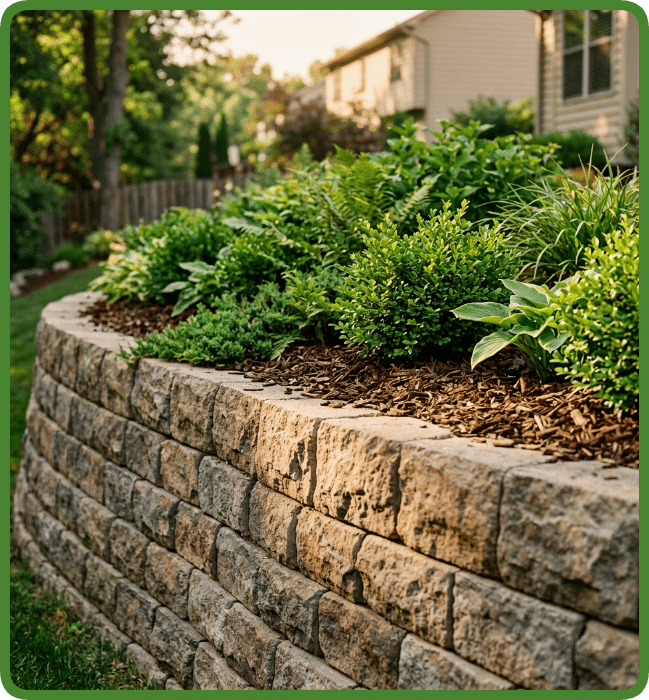

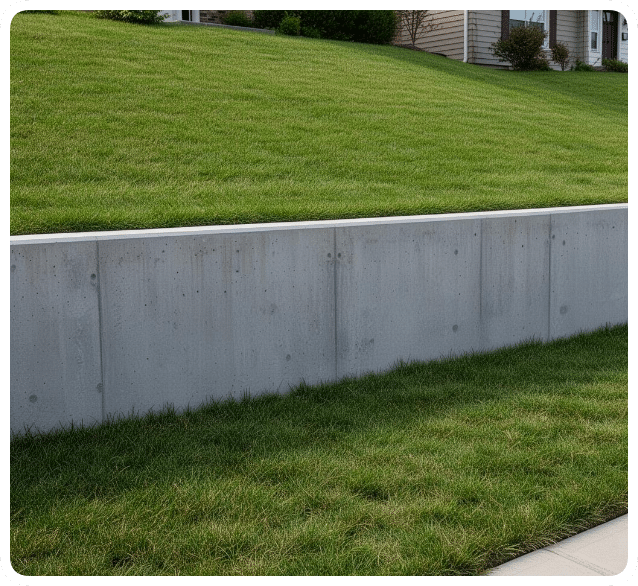
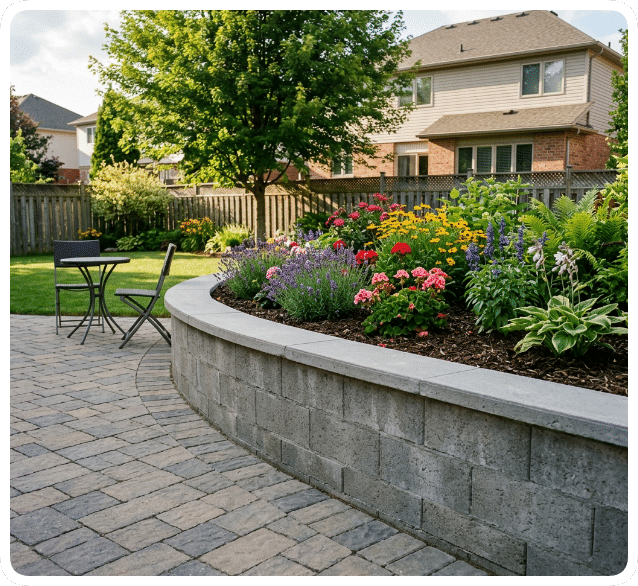
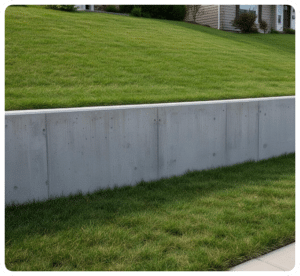
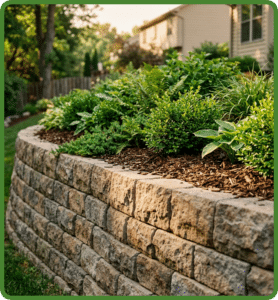
Concrete retaining walls do not have to look utilitarian. The same material that holds back a hillside can be finished to look like natural stone, brick, cobblestone, or exposed aggregate, and when it is done well, it reads as a deliberate design feature rather than a functional necessity.
Stamped concrete gives you pattern and texture, slate, fieldstone, brick coursing, and cobblestone are all achievable finishes that complement most home exteriors and landscaping styles. Stained and colored concrete can be matched to your patio surface, your home's exterior palette, or the tone of your garden plantings. Exposed aggregate adds a natural, pebbled texture that sits well alongside planted borders and organic landscaping.
A lot of our customers use a retaining wall project as the anchor for a broader outdoor space, combining the wall with a patio pour, a set of steps, or a walkway, all finished in the same material family. The result is a cohesive outdoor space that looks considered rather than assembled from separate decisions made at different times.
The most common cause of retaining wall failure is water, not the visible surface water that runs off after rain, but the water that saturates the soil behind the wall and has nowhere to go. As it builds up, it creates hydrostatic pressure that pushes against the wall face. Given enough time and enough moisture cycles, that pressure will move even a well-built wall out of alignment.
Every retaining wall we build includes drainage provisions appropriate to the site conditions. That might be a gravel backfill layer that allows water to dissipate, a perforated drain pipe running behind the wall and daylit at the ends, or weep holes through the wall face that relieve pressure before it builds to a damaging level. The right solution depends on the site — the slope, the soil type, the volume of water the site collects, and what is uphill of the wall.
We also look at how surface water is being managed above and below the wall, because a drainage solution that handles what is behind the wall but ignores what is flowing across the top of it is only half a solution. Getting it right at the start is straightforward. Fixing a wall that has moved because the drainage was inadequate is a much more involved job.
The most common cause of retaining wall failure is water. When water accumulates behind a wall and has nowhere to go, the hydrostatic pressure it creates can push even a well-built wall out of alignment over time. Every retaining wall we build includes appropriate drainage provisions, whether that is a gravel backfill, a perforated drain pipe, or weep holes in the wall face, depending on the site conditions.
We also pay attention to how surface water is managed above and below the wall. Getting drainage right at the start is far less expensive than repairing or rebuilding a wall that has moved due to water pressure.
If you have a slope to manage, an erosion problem to address, or an outdoor space you want to define with a well-built concrete wall, contact us today for a free on-site estimate. We serve Richmond and all of Central Virginia. We will come out, assess the site properly, and give you a straightforward proposal for the work.




2400 Old Brick Rd Suite 164, Glen Allen, VA 23060
